ANCEL AD310 vs AD410: Which Is Better? (October 2026)
Choose the AD310 for basic engine code reading; choose the AD410 for more on-screen diagnostic tools. Both read and clear engine and emission-related codes, but the AD410 adds built-in code definitions, a color display, O2 sensor and EVAP tests, and more live-data options.
On this page (8 sections)
- ANCEL AD310 vs AD410: what changes?
- Which scanner gives you more help understanding a code?
- Which has more useful tests and live data?
- Are their screens and setup different?
- Which vehicles can they work with?
- Can either scanner handle ABS, SRS or transmission faults?
- Is the AD410 worth choosing over the AD310?
- Which should you choose: ANCEL AD310 or AD410?
Choose the AD310 for basic engine code checks; choose the AD410 if you want built-in code definitions and more diagnostic tests. In this ANCEL AD310 vs AD410 comparison, both are corded OBD2 readers for engine and emission-related faults, but the AD410 adds several ways to inspect results on its own screen.
The AD310 can show live data, freeze frame and I/M readiness. The AD410 includes those functions, plus a built-in DTC lookup library, O2 sensor and EVAP tests, and selectable live-data views.
Neither is a whole-car diagnostic tool. Both are limited to engine and emission-related diagnostics, so they won't read ABS, SRS or transmission faults.


ANCEL AD310 vs AD410: what changes?
The AD410 offers more interpretation and testing features; the AD310 covers core code reading and clearing. The extra tools matter if you want more information before deciding what to do next.
The AD310 reads and clears engine trouble codes and can display live data, freeze frame, vehicle information and I/M readiness. The AD410 also reads and clears codes, and adds built-in code definitions, O2 sensor testing and EVAP testing.
Both connect to the vehicle's OBD2 port for power. Neither needs a phone app or a separate charger to scan.
Which scanner gives you more help understanding a code?
The AD410 has built-in code definitions, while the AD310's features focus on reading and clearing codes. If you prefer an explanation on the scanner screen, the AD410 is the clearer fit.
The AD410 has more than 42,000 built-in DTC lookups and can show a definition for a selected code. That can help you understand what a code points to before you speak with a mechanic, though a code alone doesn't confirm which part has failed.
The AD310 can display code definitions on screen, but a built-in lookup count or library is not specified. If definitions are a deciding feature, the AD410 has the more clearly described lookup function.
To understand what a code reader can and cannot tell you, see how to read OBD2 codes. A code is a starting point for diagnosis, not a complete repair instruction.
Which has more useful tests and live data?
The AD410 adds O2 sensor and EVAP tests to the core functions both scanners share. Choose it if you want to check more emissions-related information from a handheld reader.
Both can show live data, freeze frame and I/M readiness. The AD410 also supports viewing all data-stream items or selecting a particular item with a graph.
The AD310 supports live data, but graphing isn't specified. For a reader built around graphs and logging, the Foxwell NT301 is another option to consider.
The NT301 has a 2.8-inch color screen, live-data graphs and logging, O2 sensor and EVAP tests, and readiness LEDs. It is also limited to engine diagnostics and doesn't handle ABS, EPB, A/C or special functions.
You can compare more options in our guide to OBD2 scanners with live data. It helps you decide whether live readings are a key need or a feature you may rarely use.
Are their screens and setup different?
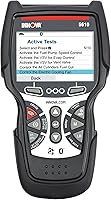
Both ANCEL scanners have a 2.4-inch screen and run from the OBD2 port. The AD410's screen is color, while the AD310 has a large display with clearly labeled buttons.
The AD410 has a 320 x 240 native resolution and a color display. The AD310's native resolution is 128 x 64, and its screen displays results clearly.
Neither scanner needs Bluetooth, an app, a battery or a charger for normal scanning. Plug it into the car's OBD2 port and turn on the ignition to begin.
If the scanner won't connect, check the port, ignition state and vehicle compatibility first. Our guide to fixing an OBD2 scanner that won't connect covers common checks.
Which vehicles can they work with?
Both are intended for many OBD2 vehicles, but you should confirm compatibility for your exact car. Model year and region are useful starting points, not a guarantee for every make and model.
The AD310 is described for most 1996 and newer North American vehicles, and 2000 and newer EU and Asian vehicles. The AD410 supports most 1996 and newer U.S. vehicles and many 2000 and newer EU and Asian vehicles, with some vehicle exceptions.
Both support major OBD2 protocols, including CAN, ISO9141, KWP2000, J1850 VPW and J1850 PWM. Compatibility can still vary by vehicle, so check before buying if your car is from a less common brand or market.
Can either scanner handle ABS, SRS or transmission faults?
No. Both are limited to engine and emission-related codes.
Choose a different tool if you need to scan ABS, airbag or transmission systems.
The AD410 excludes ABS, SRS and transmission diagnostics, along with bidirectional control and service resets. The AD310 only supports diagnosis of emission-related issues, so it cannot read engine faults unrelated to emissions.
Don't assume a scanner can read every module just because it uses an OBD2 connector. Our home diagnostic tool guide explains the difference between basic code readers and broader diagnostic tools.
Is the AD410 worth choosing over the AD310?
Pick the AD410 if its built-in definitions, O2 sensor test, EVAP test or color screen will help you use scan results. Pick the AD310 if its core engine-code functions cover what you need.
The AD310 includes live data, freeze frame and I/M readiness. If you mainly want to read or clear an engine code and check basic emissions information, its narrower feature set may be enough.
The AD410 offers more ways to inspect engine and emission-related information, but it doesn't add coverage for ABS, SRS or transmission systems. For those needs, choose a scanner that names the modules and functions you need for your vehicle.
Which should you choose: ANCEL AD310 or AD410?
Choose the AD310 for core engine and emission checks, or the AD410 for built-in definitions and added O2 and EVAP tests. Before you decide, confirm the scanner supports your vehicle and the systems you need to diagnose.
If live-data graphs matter most, consider the Foxwell NT301 as a third option. For a broader look at tools for different home-garage needs, see our home diagnostic tool guide.
| Product | Best for | Display | Code functions | Power | Our score |
|---|---|---|---|---|---|
| ANCEL AD310 Code Reader | basic code checks | 2.4 in screen | Read and clear engine codes | OBD2 port | 7.7 |
| ANCEL AD410 Code Reader | built-in code definitions | 2.4 in color display | 42,000+ built-in DTC lookups | OBD2 port | 7.6 |
| Foxwell NT301 Code Reader | live-data graphs | 2.8 in color screen | OBD2 port | 8.2 |
Frequently asked questions
What is the main difference between the ANCEL AD310 and AD410?
The AD410 adds a built-in library of 42,000+ DTC lookups, a 2.4-inch color display, O2 sensor and EVAP tests, and selectable live-data views. The AD310 handles core engine and emission-code checks, live data, freeze frame and I/M readiness.
Neither model covers ABS, SRS or transmission diagnostics.
Can the AD310 and AD410 read and clear codes?
Yes. Both can read and clear engine and emission-related codes.
Clear codes after addressing the fault, since an unresolved issue may bring the warning back.
For context on what a scanner reports, see our guide to reading OBD2 codes.
Does the AD410 work with all cars?
No scanner works with every vehicle. The AD410 supports major OBD2 protocols and is described for most 1996 and newer U.S. vehicles and many 2000 and newer EU and Asian vehicles, but compatibility varies.
Check your vehicle's year, make and model before choosing.
Can either ANCEL scanner diagnose ABS or airbag faults?
No. The AD310 and AD410 are for engine and emission-related diagnostics, not ABS or SRS faults.
If you need system-specific diagnostics, look for a tool that explicitly supports those systems for your vehicle.
Our home diagnostic tool guide covers different tool types.
Do the AD310 and AD410 need a phone app?
No. Both connect through the vehicle's OBD2 port and draw power from it, so they don't need a phone app, Bluetooth connection, battery or separate charger.
Check that your vehicle has a compatible OBD2 port and that the scanner supports its protocol.