9 Best OBD2 Scanners for All Vehicles (November 2026)
The best OBD2 scanners for all vehicles include the MOTOPOWER MP69033 Car OBD2 Scanner Code Reader (best overall for most drivers), the UMEIJA OBD2 Scanner Diagnostic Tool for phone-based live data, and the Zmoon ZM201 Professional OBD2 Scanner Diagnostic Tool for a clear color screen.
On this page (9 sections)
- The best OBD2 scanners for all vehicles, ranked
- How the OBD2 scanners compare
- How we compared these scanners
- What should you check before buying an OBD2 scanner?
- Do you need live data, or just fault codes?
- Handheld or Bluetooth: which scanner suits you?
- Which OBD2 scanner handles ABS and airbag codes?
- How much should you spend on an OBD2 scanner?
- The best OBD2 scanner for all vehicles: which one to buy
The best OBD2 scanner for all vehicles is the MOTOPOWER MP69033, because it reads and clears engine codes on most 1996-and-newer OBD2 cars without an app or a subscription. It covers 9 protocols and shows fault definitions on its own screen.
If you want live graphs and repair guidance on your phone, the UMEIJA V011 is the stronger pick. For ABS and airbag codes, the BlueDriver goes further than any reader here.
Every scanner below handles the basic job: plug into the 16-pin port, read the fault code and clear it after a repair. The differences sit in how much data you see, whether you need a phone and which vehicle systems the tool can reach.
Our score weighs specs, features and buyer feedback against what you're shopping for.
Our picks at a glance
-
1
 Best overall for most drivers
MOTOPOWER MP69033 Car OBD2 Scanner Code Reader
9.7/10 our score
See it on Amazon -
2
 Best for phone-based live data
UMEIJA OBD2 Scanner Diagnostic Tool
9.6/10 our score
See it on Amazon -
3
 Best for a clear color screen
Zmoon ZM201 Professional OBD2 Scanner Diagnostic Tool
9.5/10 our score
See it on Amazon
The best OBD2 scanners for all vehicles, ranked
The MOTOPOWER MP69033 takes the top spot for most drivers because it covers every common protocol and works without a phone. Each pick below wins on a different need, from phone-based live data to ABS coverage.
MOTOPOWER MP69033 Car OBD2 Scanner Code Reader: Best overall for most drivers
- Reads and clears engine codes
- Built-in DTC lookup library
- Supports 9 protocols
- 2.8 in backlit LCD
A corded code reader that covers every common OBD2 protocol and needs no phone, battery or app. The screen and button layout suit quick engine-light checks.
Pros
- Works across 9 protocols
- Built-in fault code library
- No battery or charger needed
- Screen protector film included
Cons
- Engine codes only, no ABS or airbag
- No live graphs in app form
The MP69033 suits the driver who wants one tool in the glovebox for a check engine light. It reads and clears engine codes, shows the fault definition from its built-in library, and pulls VIN, freeze frame and readiness data.
Its 2.8 in LCD has a white backlight and contrast adjustment, so the readout stays clear in daylight or at night. The tool draws power from the car's port, so there's no battery to charge.
Six buttons handle scrolling and quick VIN or fault code queries.
Nine protocols cover most 1996-and-newer US cars plus 2000-and-newer European and Asian models. Six menu languages help if English isn't your first choice.
The 2.5 ft cable has thick, flexible insulation.
The trade-off is scope: it reads engine codes only, so ABS and airbag faults stay invisible. A screen protector film ships on the display and can be peeled off if it scratches.
At 10.2 ounces it's light enough to leave in the car without noticing it.
Buy it for a no-fuss reader that works on almost any car. Skip it if you need ABS coverage or app-based repair guidance.
UMEIJA OBD2 Scanner Diagnostic Tool: Best for phone-based live data
- Bluetooth 5.4 connection
- Free app for iOS and Android
- Live data charts
- Reads VIN and freeze frame
A small Bluetooth adapter that turns your phone into a diagnostic screen. The app draws live sensor readings as charts, which helps when you want to watch a reading change.
Pros
- Bluetooth 5.4 for a faster link
- Chart view of live data
- Free app for iOS and Android
- Reads VIN and freeze frame
Cons
- Needs your phone and the app
- Not for ABS or airbag systems
The UMEIJA V011 suits the driver who'd rather read diagnostics on a phone screen. Its Bluetooth 5.4 link connects to the free OBD Home app on iOS and Android, and the app draws live readings as charts.
Those charts matter when you're watching a reading change as you drive. Engine coolant temperature, engine speed, vehicle speed and control module voltage all show in a visual form that's easier to compare against normal values than a scrolling number.
It supports 9 protocols and covers over 96% of car makes and models from 1996 onward, with nine app languages. The app also reads VIN, freeze frame and emission readiness, and it can clear codes after a repair.
The adapter is small enough to leave plugged in, though UMEIJA suggests unplugging it after use so it doesn't draw on the car battery.
One practical note: codes clear only after the car is repaired. The setup needs the ignition on and the phone's Bluetooth on, and on iPhone you let the app handle pairing rather than the phone's Bluetooth settings.
Buy it for affordable live data on a phone you already own. Skip it if you don't want to rely on an app every time you scan.
Zmoon ZM201 Professional OBD2 Scanner Diagnostic Tool: Best for a clear color screen
- 2.8 in color display
- Live data stream in graph view
- 50,000+ code database
- Lifetime software updates
A handheld reader with a bright color screen and a wide fault code library. It covers engine diagnostics only, so it suits buyers who want clarity without paying for systems they don't need.
Pros
- Color screen with light and dark modes
- Live data in graph view
- Large built-in code library
- Free lifetime software updates
Cons
- Engine system only
- Not for hybrid or new energy vehicles
The Zmoon ZM201 suits buyers who want a proper screen without a phone. Its 2.8 in color display has adjustable brightness plus light and dark modes, which keeps it readable in a sunny driveway or a dim garage.
The 320x240 resolution is sharper than the mono screens on cheaper readers.
The built-in database holds more than 50,000 fault codes, so most engine lights come with a definition on screen. Live data, freeze frame, O2 sensor tests and EVAP checks go beyond simple code reading.
Shortcut keys and vehicle status indicators keep the menus short.
Protocol support covers KWP2000, ISO9141, J1850 VPW, J1850 PWM and CAN. Zmoon lists coverage from 1996 for US cars, 2002 for European cars and 2008 for Asian cars, and it warns that hybrids and new energy vehicles aren't covered.
It's engine diagnostics only, so it won't read ABS, SRS or transmission systems. Permanent fault codes need a repair before they'll clear.
Lifetime software updates keep the code list current, and a PC connection supports Windows XP through 10 for data review and printing.
Buy it for a color screen and a big code library at a mid-range price. Skip it for ABS work or a hybrid daily driver.
FIXD Bluetooth OBD2 Scanner: Best for plain-English fault explanations

- Free app with unlimited scans
- Plain-language issue explanations
- Tracks multiple vehicles
- Works on gas and hybrid cars
A tiny Bluetooth sensor paired with an app that explains what triggered the warning light. It suits drivers who want to know whether a fault is serious before driving to a shop.
Pros
- Plain-English explanations
- Free app with unlimited scans
- Saves scans for several cars
- Works on gasoline and hybrid vehicles
Cons
- Needs your phone for every scan
- Some features sit behind an optional upgrade
FIXD suits the driver who wants a plain-English answer rather than a code number. The small sensor pairs with a free app that explains what triggered the warning light and how urgent it is.
The app alerts you when FIXD spots a severe issue or needed maintenance.
The app saves scans by vehicle, so a household with several cars can keep records in one place. It also tracks mileage-based reminders, which helps when maintenance slips past the sticker date.
Results can be shared with family or a shop.
It works on gas and hybrid vehicles from 1996 and on diesel vehicles from 2006. FIXD says the app covers more than 39,000 issues across thousands of vehicles.
At 1.75 in tall and about an ounce, the sensor hides under the dash.
The free app gives unlimited scans. Some deeper features, like repair cost estimates, vehicle value and live mechanic support, sit inside an optional premium upgrade.
Features can vary by make and model.
Buy it for clear explanations and multi-car tracking. Skip it if you want every feature included without an upgrade.
BlueDriver Bluetooth OBD2 Scanner: Best for ABS and airbag codes

- Reads ABS, SRS, airbag and TPMS codes
- Repair reports tied to your VIN
- No subscription fees
- Live data and Mode 6 results
A Bluetooth scanner that reaches systems basic readers can't, including ABS and airbags on supported vehicles. The app pairs codes with repair reports for your VIN.
Pros
- Reads ABS, SRS, airbag and TPMS codes
- Repair reports tied to the VIN
- No subscription fees
- Live data and Mode 6 tests
Cons
- Premium price tier
- Enhanced coverage varies by make and model
The BlueDriver goes past engine codes. On supported vehicles it reads and clears ABS, SRS, airbag and TPMS codes, which basic readers here can't touch.
That's the reason it costs more. Coverage expands on newer model years and select 2024+ Nissan and Mazda models get enhanced communication.
The app pairs fault codes with repair reports matched to your VIN. Each report gives definitions, likely causes and confirmed fixes, which saves time when you're deciding between a shop visit and a driveway repair.
In-app how-to videos cover common repairs.
It also shows live data as you drive, plus freeze frames, smog readiness and Mode 6 test results. There are no subscription fees, so one purchase covers the full feature set.
The scanner is optimized for GM, Ford, Stellantis, Toyota, Honda, Nissan, Mazda, Subaru, Hyundai, Mercedes-Benz, BMW and VW.
Coverage runs to 1996-and-newer gas vehicles plus select light-duty trucks and diesels. Enhanced coverage varies by make and model, so the deep features depend on what you drive.
Hybrids scan for standard OBD2 emissions and engine codes.
Buy it for ABS and airbag diagnostics without a subscription. Skip it if you only ever need engine codes and want to spend less.
Innova 5210 Code Reader: Best for battery and oil reset checks

- Built-in battery and alternator tester
- Reads and clears engine and ABS codes
- Live data and oil light reset
- Free RepairSolutions2 app
A handheld reader that also checks battery and alternator health. The oil light reset and smog readiness checks make it useful between engine faults.
Pros
- Battery and alternator testing built in
- Oil light reset
- Live data readings
- Free app with verified fixes
Cons
- ABS coverage varies by vehicle
- Engine-focused diagnostics
The Innova 5210 suits the owner who wants more than a code reader in one handheld. It reads and clears engine codes plus ABS codes on covered vehicles, and it doubles as a battery and alternator tester.
That battery check helps before a long trip or a cold winter, when a weak alternator turns into a no-start.
Live data covers RPM, engine temperature, fuel trims and oxygen sensor readings. The oil light reset handles maintenance lights after a change, and the drive cycle readiness feature confirms smog test status.
The free RepairSolutions2 app adds verified fixes from ASE-certified mechanics, suggested parts and cost estimates with no subscription.
The scanner has a 2.8 in screen and draws power from the car. Innova asks buyers to run its coverage checker first, since features vary across makes, models and years.
ABS coverage varies by make and model, so check that detail for your car. Its engine and battery focus means it sits between a basic reader and a full-system tool.
Our full Innova 5210 review covers the details.
Buy it for engine codes plus a battery check in one tool. Skip it if you need full ABS coverage on every vehicle.
Foxwell NT301 Code Reader: Best for smog test preparation
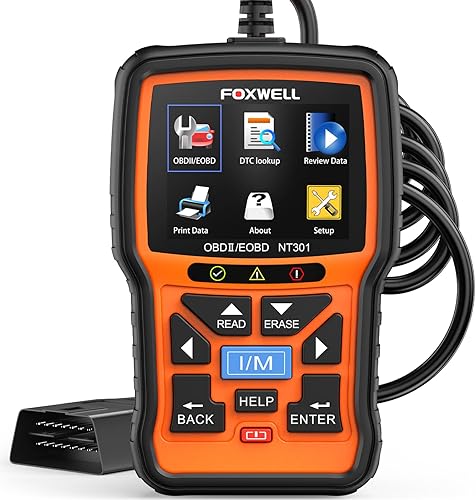
- Red, yellow and green readiness LEDs
- Live data graphs
- O2 sensor and EVAP tests
- Lifetime free updates
A corded reader with a one-click readiness check and simple status lights. It suits drivers who want to know whether monitors will pass before an emissions test.
Pros
- Clear readiness indicator lights
- Live data graphing
- O2 sensor and EVAP tests
- Lifetime free updates
Cons
- No ABS or airbag scanning
- Windows only for updates
The Foxwell NT301 suits drivers who want to know if their car will pass an emissions test. Its readiness hotkey and red, yellow and green LEDs give a straight pass-or-fail signal without scrolling menus.
A built-in speaker adds an audible cue.
Beyond readiness, it reads and clears engine codes and runs EVAP and O2 sensor tests. Live data graphs let you watch oxygen sensors, fuel trims, coolant temperature and RPM in real time.
A Help button offers possible causes when a code has a question mark beside it.
It covers all five protocols and works on most 1996-and-newer gas cars, light trucks and SUVs sold in the US. Some 2000-and-newer European and Asian models are supported too.
The screen is 2.8 in color and readable in daylight. Updates run on Windows only, which is a snag for Mac owners.
There's no ABS, airbag or EPB scanning here, and no bidirectional controls. Foxwell lists lifetime free updates.
Buy it for smog prep and live engine data. Skip it if you need to update from a Mac or read non-engine systems.
ANCEL AD310 Code Reader: Best for a first scanner on a budget

- Reads and clears engine codes
- Live data and freeze frame
- Supports all five OBD2 protocols
- No battery needed
A simple corded reader that covers the five common OBD2 protocols. It's a low-cost way to read a check engine light without a phone in the mix.
Pros
- Supports all five OBD2 protocols
- Live data and freeze frame
- Compact and light
- No battery or charger
Cons
- No reset or service functions
- Emission-related codes only
The ANCEL AD310 suits a first-time buyer who wants the basics without spending much. It reads and clears engine codes, shows live data and freeze frame, and covers all five OBD2 protocols.
Its 2.4 in screen is smaller than the color displays on the Zmoon or Foxwell, but the readout stays clear and the buttons are labelled. The 2.5 ft cable has thick insulation, and the body is compact enough for a backpack.
ANCEL runs each unit through a 48-hour aging test before shipping.
It reads emission-related codes and clears them after a repair. It doesn't do reset or service functions, so maintenance lights stay on.
It also won't read engine faults that sit outside the emission system. An OBD1 car won't work even with an adapter.
No battery or charger is needed, since the tool draws power from the port. For a simple engine light, it does the core job at a budget price.
Buy it for a cheap first reader with no app. Skip it if you need reset functions or non-emission engine faults.
ANCEL AD410 Code Reader: Best for built-in code definitions

- 42,000+ built-in code definitions
- 2.4 in color display
- Live data and I/M readiness
- No app required
A corded reader that shows what a code means on its own screen. It suits drivers who don't want to pair a phone just to understand a warning light.
Pros
- Large built-in code library
- Color screen with clear menus
- Live data and readiness check
- No phone or app needed
Cons
- Engine and emission codes only
- No ABS or transmission support
The ANCEL AD410 suits drivers who want to understand a code without pairing a phone. It carries more than 42,000 built-in definitions, so the meaning of most engine codes shows on its 2.4 in color screen.
Menu shortcuts and status indicators keep it simple for new drivers.
It reads and clears engine codes and shows live data like RPM, coolant temperature, fuel trim and oxygen sensor readings. The I/M readiness check tells you whether monitors are set before a smog test.
O2 sensor and EVAP tests add a little more depth.
All five protocols are supported, with coverage from 1996 for US cars and 2000 for European and Asian models. Free software updates keep the code library current.
Updates run on Windows 7, 8 and 10; Mac and Windows XP aren't supported. ANCEL notes some European makes, including Fiat, Alfa and certain Peugeot and Renault models, won't work.
It's engine and emission codes only. ABS, SRS and transmission systems need a different tool.
It's also a small step up in price from the AD310 for the bigger code library and color screen.
Buy it for on-screen code definitions and a color display. Skip it if you need ABS or transmission diagnostics.
How the OBD2 scanners compare
The table below lines up the main differences: connection type, screen size, vehicle coverage and which systems each tool reaches. Read it by the feature you need most.
| Product | Best for | Screen | Power | Vehicle coverage | Our score |
|---|---|---|---|---|---|
| MOTOPOWER MP69033 Car OBD2 Scanner Code Reader | overall for most drivers | 2.8 in LCD, 128x64 | From the car's OBD2 port | 1996+ US, 2000+ EU and Asian cars | 9.7 |
| UMEIJA OBD2 Scanner Diagnostic Tool | phone-based live data | 9.6 | |||
| Zmoon ZM201 Professional OBD2 Scanner Diagnostic Tool | a clear color screen | 2.8 in color, 320x240 | From the car's OBD2 port | 1996+ US, 2002+ EU, 2008+ Asia | 9.5 |
| FIXD Bluetooth OBD2 Scanner | plain-English fault explanations | Gas 1996+, diesel 2006+ | 9.4 | ||
| BlueDriver Bluetooth OBD2 Scanner | ABS and airbag codes | 1996+ gas, select light diesels | 9.0 | ||
| Innova 5210 Code Reader | battery and oil reset checks | 2.8 in | Vehicle powered | 1996+ US, Asian and European | 8.7 |
| Foxwell NT301 Code Reader | smog test preparation | 2.8 in color | Corded from the OBD2 port | 1996+ gas, 2000+ EU and Asian | 8.2 |
| ANCEL AD310 Code Reader | a first scanner on a budget | 2.4 in | From the OBD2 port | 1996+ US, 2000+ EU and Asian | 7.7 |
| ANCEL AD410 Code Reader | built-in code definitions | 2.4 in color, 320x240 | From the OBD2 port | 1996+ US, 2000+ EU and Asian | 7.6 |
How we compared these scanners
We compared the specs each brand publishes and matched them against what drivers actually need from an OBD2 scanner. Protocol support came first, since a tool that misses a protocol won't connect to some cars at all.
All five common protocols are the baseline, and the count of nine in the MOTOPOWER and UMEIJA specs covers the same set.
Vehicle coverage came next. A reader listed for 1996-and-newer US cars and 2000-and-newer European models handles more of the road than one limited to a narrower range.
The Asian year matters too, since Zmoon lists 2008 while others stop at protocol support without a year.
Then we weighed what each tool does beyond reading a code. Live data, readiness checks, ABS coverage, battery testing and app support all change how useful a scanner is once the novelty of reading a code wears off.
A battery tester or an oil reset earns its place in a tool you'll keep.
Finally we looked at setup: whether it needs a phone, an app, a battery or a computer for updates. A corded reader that works out of the box wins for most people, while an app-based tool wins when you want saved scans and repair help.
Update requirements count here, since a Windows-only updater is a real limit for Mac households.
What should you check before buying an OBD2 scanner?
Start with protocol support and the year your car was built. Every scanner here handles the five common protocols, but the coverage years differ slightly between models.
A 1996 US car needs a basic OBD2 reader. A 2000 European car or a 2008 Asian car needs a tool listed for those years.
Zmoon, for example, lists 2002 for EU cars while several others list 2000. Check the coverage years for your car's year and region before you pay.
Vehicle system coverage
Check what you need to read. Engine codes are the baseline.
ABS, airbag, transmission and TPMS codes need enhanced coverage like the BlueDriver's. Battery testing and oil resets need a tool like the Innova 5210.
If a light on your dash isn't the check engine light, a basic reader won't help.
Screen or phone
Then decide between a screen and a phone. A handheld reader works without an app.
A Bluetooth scanner needs your phone, but it saves scans and shows charts you can study later. Think about when you scan: in a driveway with your phone in hand, or roadside with the phone possibly dead.
Do you need live data, or just fault codes?
Live data matters if you plan to diagnose a problem yourself. It shows what the engine is doing in real time, so you can spot a reading that drifts outside its normal range.
Fuel trims and oxygen sensor readings are the usual places to look first.
A basic reader tells you the code and the definition. That's enough to know whether a fault is serious and whether to book a shop visit.
A code plus live data lets you narrow down a cause before you spend money. A freeze frame captures the conditions at the moment the fault set, which helps too.
Handheld readers like the Zmoon and Foxwell show live data in graph form on their own screens. Bluetooth tools like the UMEIJA and BlueDriver push richer charts to a phone.
Our guide to the best OBD2 scanners with live data compares those options in detail.
If you only ever want to clear a light after a repair, skip the live data and save the money.
Handheld or Bluetooth: which scanner suits you?
Handheld scanners
A handheld reader plugs into the port and shows everything on its own screen. There's no phone to pair, no app to install and no battery to charge.
It's the simplest option when a light comes on and you just want the code.
Handhelds like the MOTOPOWER, Zmoon and Foxwell also work when your phone is dead or out of signal. Updates, when a model offers them, run through a computer.
A handheld also suits a shared car, since there's no account or app tied to one person's phone.
Bluetooth scanners
A Bluetooth tool is a small adapter that pairs with your phone. The app does the heavy lifting: saved scans, live charts and repair guidance.
That's more detail than most handheld screens can show.
The catch is dependence on the phone and the app. Setup takes a few more steps, and app quality varies between brands.
On iPhone, the pairing process differs from Android, so read our guide to the best OBD2 scanner for iPhone before you choose. FIXD and BlueDriver both keep scans saved by vehicle, which is the main reason to go wireless.
An all in one OBD2 scanner can bridge both worlds by combining a screen with app support, but expect to pay more.
Which OBD2 scanner handles ABS and airbag codes?
Only a scanner with enhanced coverage reads ABS or airbag codes. Of the tools here, the BlueDriver is the clear pick, since it reads and clears ABS, SRS, airbag and TPMS codes on supported vehicles.
It also reaches transmission codes on covered makes.
The Innova 5210 also reads ABS codes on covered vehicles, though coverage varies by make and model. That makes it a useful middle option for a driver who wants engine and battery checks plus some brake system coverage.
The rest of the readers here are engine-only. They'll clear a check engine light but won't touch an ABS warning or an airbag light.
The ANCEL AD310 even limits itself to emission-related engine faults. If those systems matter to you, budget for enhanced coverage and check the compatibility chart first.
How much should you spend on an OBD2 scanner?
A budget reader covers engine codes for the least money. The ANCEL AD310 and AD410 sit in that tier and do the core job without an app.
The AD410 adds a color screen and a larger code library for a small step up.
Mid-range handhelds add color screens, bigger code libraries and live data. The Zmoon and Foxwell fit here, and the Innova 5210 adds battery testing and oil reset to the mix.
The MOTOPOWER sits at the value end of this group with its wide protocol support.
Premium tools reach more systems. The BlueDriver and FIXD sit in that tier, with enhanced coverage or app-based repair guidance.
Bluetooth tools often cost more than a basic reader for the same engine codes, so pay for the extra features only if you'll use them. A no-subscription tool like BlueDriver avoids ongoing fees that some app tools charge.
The best OBD2 scanner for all vehicles: which one to buy
The MOTOPOWER MP69033 is the best OBD2 scanner for all vehicles for most drivers, because it covers 9 protocols, reads and clears engine codes and needs no phone. Buy the UMEIJA if you want live charts on your phone, or the BlueDriver if ABS and airbag codes matter.
Pick the Zmoon ZM201 when a color screen and a large code library are your priority. Pick the Innova 5210 if you also want to test the battery and reset the oil light.
For smog test preparation, the Foxwell NT301 gives the clearest pass-or-fail signal.
If you're on a tight budget and only need engine codes, the ANCEL AD310 does the job. Start with your car's year and the systems you need to read, then choose the cheapest tool that covers both.
Our top 3 picks at a glance
-
1
Best overall for most drivers
MOTOPOWER MP69033 Car OBD2 Scanner Code Reader
9.7/10 our score
See it on Amazon -
2
Best for phone-based live data
UMEIJA OBD2 Scanner Diagnostic Tool
9.6/10 our score
See it on Amazon -
3
Best for a clear color screen
Zmoon ZM201 Professional OBD2 Scanner Diagnostic Tool
9.5/10 our score
See it on Amazon
Frequently asked questions
What makes an OBD2 scanner work on all vehicles?
An OBD2 scanner needs to support all five common protocols: CAN, ISO9141, KWP2000, J1850 VPW and J1850 PWM. It also needs to work with 1996-and-newer US cars, 2000-and-newer European cars and 2008-and-newer Asian cars.
Check the protocols before buying.
Do I need a Bluetooth scanner or a handheld one?
Pick a handheld reader if you want to read a check engine light without your phone. Pick a Bluetooth scanner if you want live charts, saved scans and repair guidance in an app.
A handheld is faster to grab; a Bluetooth tool is easier to read in detail.
Can an OBD2 scanner clear a check engine light?
Yes, most scanners clear engine codes. The light often returns if the underlying fault isn't fixed.
Clear codes only after a repair, then drive through a full cycle so the readiness monitors reset.
Will a basic OBD2 scanner read ABS or airbag codes?
No, most basic readers only handle engine and emission codes. Reading ABS, SRS or airbag codes needs a scanner with enhanced coverage for those systems.
Check the feature list before buying if those systems matter to you.
Why won't my scanner connect to my car?
The ignition usually needs to be on before the scanner connects. Plug the tool in firmly and press it until it clicks into the port.
Live data needs the engine running.
If it still fails, check that the port has power.