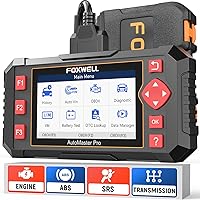
9 Best Affordable Car Code Readers (November 2026)
The best affordable car code readers include the MOTOPOWER MP69033 Car OBD2 Scanner Code Reader (best overall), the Autel OBD2 Scanner MS309 for smog check prep, and the FIXD Bluetooth OBD2 Scanner (best phone-based reader).
On this page (9 sections)
- Which affordable code readers work for which driver
- How these affordable readers compare
- How we compared the best affordable car code readers
- What should a budget code reader do first?
- Should you choose a handheld reader or a phone dongle?
- Which cheap readers help with a smog check?
- Do you need ABS or airbag codes from a budget reader?
- Do these readers work on older and newer cars?
- The best affordable car code reader for most drivers
The best affordable car code reader for most drivers is the MOTOPOWER MP69033, because it covers every check engine job on its own: reading codes, clearing them, freeze frame, I/M readiness and live data, all on a 2.8 in screen.
The FIXD is the pick if you would rather see plain-English explanations on your phone. The Autel MS309 wins on code definitions and smog-check prep.
Every pick here sits in the budget end of the market and runs from your car's OBD2 port, so you never buy batteries. This guide focuses on the readers you plug in, hold in your hand and use in the driveway.
Our picks at a glance
-
1

-
2

-
3

Which affordable code readers work for which driver
A handheld reader suits most people, but the right cheap scanner depends on whether you prefer a built-in screen or a phone app. The order below runs from the highest score to the lowest.
MOTOPOWER MP69033 Car OBD2 Scanner Code Reader: Best overall
- 2.8 in LCD with backlight
- Built-in DTC lookup library
- 9 supported protocols
- 6 languages
A standalone reader that covers the check engine basics without a phone. The built-in code library and large screen make the first scan easy.
Pros
- Built-in code definitions
- Live data and freeze frame
- Long cable and clear screen
Cons
- No ABS or airbag codes
- DTC button wording takes a first read
MOTOPOWER's MP69033 is the one to buy if you want one tool that answers the check engine light without a phone. Its 2.8 in LCD has a white backlight and contrast adjustment, so the codes stay readable in a dim garage.
A built-in dictionary explains the code the moment you read it. It also shows freeze frame, I/M readiness, vehicle information, live data and a real-time curve, plus engine speed, coolant temperature and load value.
It supports 9 protocols for most 1996 US, 2000 EU and later Asian cars, and speaks 6 languages. Six buttons handle scrolling, entering and exiting, plus quick VIN and DTC lookups.
Two practical limits show up against the others. It reads engine and emission codes only, so ABS and airbag faults stay off the menu.
Its cable is a solid 2.5 feet, which suits most ports but leaves little slack in a tight footwell.
The screen comes with a protecting film you can peel off once it scratches, and the body measures 2.75 by 0.91 by 6.02 in. For most drivers, that trade is worth it.
Autel OBD2 Scanner MS309: Best for smog check prep
- 1000+ code database
- I/M readiness monitors
- Freeze frame and VIN
- Plug and play, no registration
On-screen code meanings save a lookup on your phone. I/M readiness readout suits drivers facing an emissions test.
Pros
- Code definitions on screen
- Reads VIN and calibration IDs
- No registration needed
Cons
- Tiny screen
- No access to FCA vehicles after 2017
Autel's MS309 is the second pick, and its edge is code explanations. The built-in database covers more than 1000 codes with their meanings shown under each code, so you don't search the web for a definition.
It reads generic, manufacturer-specific and pending codes. It also retrieves freeze frame and vehicle information such as the VIN, calibration IDs and calibration verification numbers, which helps when you check whether a used car's computer matches its paperwork.
I/M readiness is the other reason to choose it. It shows monitor status for misfire, fuel system, catalyst, oxygen sensors and EVAP, so you know whether the car is ready for an annual smog check before you drive there.
The setup suits a beginner. It is plug and play, needs no registration and no battery, and Autel provides a PDF manual.
The limits come with caution. Autel says the MS309 cannot clear codes on FCA vehicles made after 2017 because of the Safe Gateway security system, and it does not cover TPMS or service functions.
It also reads the basic engine side only, not the full engine system that Autel's pricier models handle.
The screen is small next to the MOTOPOWER. Read the on-screen definitions slowly on that 1 in display and it does the job.
FIXD Bluetooth OBD2 Scanner: Best phone-based reader
- Bluetooth to iPhone and Android
- Free app with unlimited scans
- Plugs in and stays hidden
- Supports 1996+ gas and hybrid cars
Turns your phone into the display and explains codes in plain English. Leave the small sensor plugged in and scan whenever a light comes on.
Pros
- Plain-English explanations
- Stays plugged in under the dash
- Tracks several family vehicles
Cons
- Needs your phone every scan
- Premium features are an optional upgrade
The FIXD is the best phone-based option. The dongle is small enough to stay hidden under the dash, and it talks to an iPhone or Android by Bluetooth.
The free app makes sense of what it finds.
Instead of raw codes, you get plain-English notes on 39,000+ issues across thousands of vehicles, plus alerts when something severe turns up. Saving scans by vehicle and setting mileage reminders helps when a household runs two or three cars.
It covers gasoline and hybrid vehicles from 1996 and diesel from 2006. The app is free with unlimited scans for your family's cars.
A free premium trial adds repair recommendations, cost estimates, vehicle value by condition and live mechanic support, and that upgrade is optional.
The body measures 1.5 by 0.5 by 1.75 in and weighs about an ounce, so it fits behind a trim panel and is easy to forget until a light comes on. Features can vary by vehicle make and model, so a few older cars show less detail.
The trade is phone dependence. The dongle is useless without the app, and the app needs your phone present at every scan.
That is the opposite of the MOTOPOWER, which works alone.
Choose FIXD if clear words matter more than a standalone screen. Skip it if you want a tool that lives in the glovebox and works without pairing.
VDIAGTOOL VD10 OBD2 Scanner Check Engine Code: Best for hands-off diagnosis

- 3000+ code database
- Live data and freeze frame
- I/M readiness and VIN
- All five OBDII protocols
A screen reader with a large code library and the emission checks a test center looks for. Good for a driver who wants answers without an app.
Pros
- Built-in code lookup
- Smog readiness check
- Covers all OBDII protocols
Cons
- Two-line screen limits live data
- Beaten on features by the top two
The VD10 is a middle option: a handheld reader with a bigger library than the ANCEL AD310 and the same standalone approach as the MOTOPOWER. More than 3000 codes show their definitions on the screen, including generic, manufacturer-specific and pending ones, so no web lookup is needed.
Live data covers RPM, intake air temperature, short and long term fuel trim and misfire data, and freeze frame helps with intermittent faults. I/M readiness readout is aimed at drivers facing a smog check or state inspection.
It supports all five OBDII protocols and covers 99% of OBD2-compliant vehicles, VDIAGTOOL says. The brand lists it for post-1996 US, post-2006 EU and post-2009 Asian cars, 12V cars, SUVs and light trucks, and it also pulls the VIN, calibration IDs and CVNs for a used-car check.
The 2.1 in two-line screen is the weak point: it shows codes well but struggles to present much live data at once. VDIAGTOOL backs the VD10 with warranty coverage and it speaks 6 languages.
Pick it if you want a large code library on a screen you own. The MOTOPOWER and MS309 beat it on screen size and data display, which is why it sits behind them.
Foxwell NT301 Code Reader: Best for live data graphing
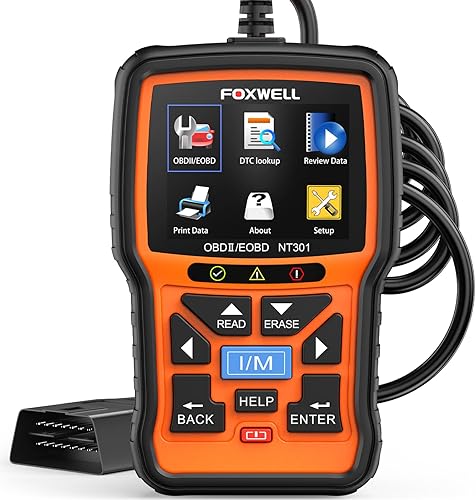
- 2.8 in color screen
- Live data graphed
- O2 sensor and EVAP tests
- One-click I/M readiness
Goes past code reading with graphs and sensor tests. The color screen makes live sensor data easier to follow.
Pros
- Color screen with graphs
- O2 sensor and EVAP testing
- Audio feedback and LED readiness lights
Cons
- Needs a Windows PC for updates
- No ABS or airbag codes
The Foxwell NT301 is the pick when you want to watch how the engine behaves, not just what code it stored. Its 2.8 in color screen graphs live sensor data, so oxygen sensors, fuel trims, coolant temperature and RPM show as trends rather than numbers.
It also runs an EVAP system check and an O2 sensor test, which goes beyond the basic code readers here. One-click I/M readiness comes with red, yellow and green LEDs, and a speaker beeps feedback.
Foxwell says it clears codes only after you fix the cause, so the light reappears if the repair is incomplete. That honesty is useful when you verify a repair, and a help button gives possible causes for a code.
The trade-off is setup and coverage. Updates need a Windows PC, and Mac and iOS do not work.
It reads engine and emission codes only, and it cannot scan ABS, EPB or A/C systems or run resets and calibration. It sits below the top four on score because you pay for features most drivers never touch.
Choose it if live graphs of sensors help your diagnosis. Otherwise the MOTOPOWER covers the same basics on a simpler screen.
ANCEL AD310 Code Reader: Best simple pick

- Reads and clears engine codes
- Live data and freeze frame
- I/M readiness
- Supports all OBDII protocols
A compact, sturdy reader that handles the check engine basics. It suits a driver who wants one simple tool and nothing else.
Pros
- Light and compact
- Clear on-screen results
- Handles all OBDII protocols
Cons
- No live graphing
- Engine and emission codes only
The ANCEL AD310 is the simplest pick here. It reads and clears engine codes, shows live and stored data, freeze frame and I/M readiness, and collects vehicle information.
It supports all OBDII protocols, from KWP2000 and J1850 to CAN.
It is light at 12 ounces and compact at 8.9 by 6.9 by 1.4 in, with a 2.5 ft cable of thick, flexible insulation. A 2.4 in screen shows results clearly.
There is no battery and no charger, since the OBD2 port powers it.
Each unit gets a 48-hour factory aging test, and the rugged case is meant to survive a drop in the garage. The quick code reading is its strength, and a driver with no car knowledge can follow the menu.
The limits are real: no live graphing, no O2 or EVAP test, no reset functions, and engine and emission codes only. ANCEL also points owners to the FX6000 if they need ABS, SRS or transmission codes.
If you want the lowest-cost tool that walks you through a check engine light, this is it. It is the calm, minimal choice for a first-time DIY owner who just wants a code and a definition.
ANCEL AD410 Code Reader: Best for a bigger code library

- 42,000+ DTC lookups
- O2 sensor and EVAP tests
- Live data
- 2.4 in color display
A color-screen reader with a very large built-in code library. Beginners get code meanings without leaving the driver's seat.
Pros
- Huge DTC library
- Color screen
- Free updates
Cons
- Screen is small for live data
- Engine and emission codes only
The AD410 is the better of ANCEL's two readers. It has 42,000+ built-in code lookups, a 2.4 in color display and free software updates, and it adds O2 sensor and EVAP tests that the AD310 skips.
Live data covers RPM, coolant temperature, fuel trim and oxygen sensor readings on the screen. I/M readiness tells you before a smog test whether the monitors are set after a repair.
No app, Bluetooth or battery is needed, and the menu needs no setup, which makes it friendly to new drivers.
The body is compact at about 3 by 4.9 in and just over 10 ounces. The engine and emission scope stays the same.
ABS, SRS and transmission codes are out of reach, as are service resets and bidirectional control, and ANCEL says so directly.
Choosing between it and the AD310 comes down to that color screen and the larger code list. The score gap is small because both tools do the same core job, and the update cable is a USB job you can do on a normal computer.
Pick the AD410 if color and a bigger dictionary help you read results faster. Pick the AD310 if you want the lower-cost, lighter tool and nothing more.
Veepeak OBDCheck BLE: Best for app flexibility

- Bluetooth LE and Classic
- Works with third-party apps
- iOS and Android
- Small carrying case
A small adapter that pairs with the app you choose instead of a locked-in one. Suits drivers who like picking their own software.
Pros
- Works with several apps
- Bluetooth LE for iOS
- Compact and easy to store
Cons
- No app included
- Some app features cost extra
The Veepeak OBDCheck BLE is the cheap dongle for drivers who already know which phone app they want. It is a small Bluetooth adapter for iOS and Android, with Bluetooth LE and a Classic mode for Android, and it comes with a mini case.
It handles standard OBD-II functions: reading and clearing trouble codes, freeze frame, I/M readiness and live sensor data. The apps do the explaining, so Car Scanner ELM OBD2, Torque and OBD Fusion each give a different experience, and apps built for EVs cover certain electric and plug-in hybrid cars.
That flexibility is the point, and it is also the cost. No app comes with it, some app features need a separate buy, and the advanced functions depend on the vehicle and the app.
It is not a full-system scanner, as Veepeak says, and it cannot do injector coding, EPB reset, ABS bleeding or oil resets.
Pairing is done inside the app, not in Bluetooth settings, and Android head units may not work. It does not support Carly, MHD, xHP or bootmod3, so check your app first.
For most people, the FIXD's ready-made app is friendlier.
Choose Veepeak if you like choosing your own software. Choose FIXD if you want the app decided for you.
Autel AutoLink AL319: Best low-cost Autel reader

- One-click I/M readiness
- TFT color display
- Live data and freeze frame
- 7 languages
The lowest-cost way into Autel's menu system and code library. It covers the check engine basics with a color screen.
Pros
- One-click I/M readiness
- Color screen
- Lifetime free updates
Cons
- Fewer functions than the higher picks
- No ABS or airbag codes
The Autel AL319 is the budget door into Autel's reader software, and its one-click I/M readiness is the feature to know. A single press checks the emission monitors, a useful step before an inspection.
A TFT color screen and built-in speaker give clear results, with 7 languages and a cable that is long enough without tangling. No batteries are needed, and Autel offers lifetime free updates and a 12-month warranty.
Coverage is wide: most post-1996 OBD II vehicles, including Toyota, Nissan, Honda and Ford, with read and clear, DTC lookup, live data, freeze frame and vehicle information. A VIN may come through as a manual entry on some models, since makers can block that read.
The limits mirror its price. It reads engine and emission codes only, with no ABS or SRS, and its function list is shorter than the top picks.
The AL319 also trails the MOTOPOWER and MS309 on features.
Pick it if the Autel name and the one-click readiness check matter and you want the lowest spend. The MS309 from the same brand does more with code definitions.
How these affordable readers compare
| Product | Best for | Screen | Power | Cable | Our score |
|---|---|---|---|---|---|
| MOTOPOWER MP69033 Car OBD2 Scanner Code Reader | overall | 2.8 in LCD | From the OBD2 port | 2.5 ft | 9.7 |
| Autel OBD2 Scanner MS309 | smog check prep | 1 in | OBD2 cable | 9.4 | |
| FIXD Bluetooth OBD2 Scanner | phone-based reader | Vehicle OBD2 port | 9.4 | ||
| VDIAGTOOL VD10 OBD2 Scanner Check Engine Code | hands-off diagnosis | 2.1 in LCD | From the OBD2 port | 9.1 | |
| Foxwell NT301 Code Reader | live data graphing | 2.8 in color | Corded | 8.2 | |
| ANCEL AD310 Code Reader | simple pick | 2.4 in | OBD2 port | 2.5 ft | 7.7 |
| ANCEL AD410 Code Reader | a bigger code library | 2.4 in color | OBD2 port | 7.6 | |
| Veepeak OBDCheck BLE | app flexibility | OBD2 port | 7.3 | ||
| Autel AutoLink AL319 | low-cost Autel reader | 2.4 in color | From the OBD2 port | 6.8 |
How we compared the best affordable car code readers
We compared specs and features against what a driver with a check engine light actually needs. That means the core jobs first: read the code, explain it, clear it after the repair and show I/M readiness.
Screen size, code library size and whether the tool works alone or needs a phone came next. Live data and graphs moved a pick up only when they add a real diagnostic step.
We also weighed price tier, warranty length and update policy, and how well each tool fits a first-time DIY owner. The score weighs specs, features and buyer feedback against what you're shopping for.
Facts come from the brand's published specs for each tool, and where a brand sets a limit, we state it plainly.
What should a budget code reader do first?
A budget reader must read and clear engine codes and explain what they mean, and nothing else matters if it misses those. Everything beyond that is a bonus for a more curious owner.
The MOTOPOWER and MS309 both show definitions on screen, so you don't need a phone in one hand. The ANCEL AD310 does the same job with a smaller library and a simpler screen.
If you're new to the process, our guide on how to read OBD2 codes walks through the port, the ignition and the readout order. A reader that only shows the code without a meaning still helps, since one quick search finishes the job.
It just adds a step every time.
Should you choose a handheld reader or a phone dongle?
A handheld reader suits drivers who want a tool that works without pairing, charging or an app, while a phone dongle suits drivers who prefer big text and plain English. The same engine codes come out of both.
Handheld picks here are the MOTOPOWER, MS309, VD10, NT301, AD310, AD410 and AL319. They turn on from the OBD2 port, show codes on their own screen and ask for nothing else.
That reliability is why the top pick is a handheld.
Phone picks are the FIXD and the Veepeak. The FIXD brings its own app and plain-English notes.
The Veepeak asks you to bring the app.
If you sometimes scan away from home or share the tool with family, the handheld is easier to pass around. If you read everything on a phone anyway, the dongle saves a screen you won't use.
Which one handles live data better?
The Foxwell NT301 leads on live data with color graphs, sensor tests and an EVAP check. That matters when a code points at a sensor and you want to watch it behave.
The MOTOPOWER shows live data and a real-time curve on its 2.8 in screen, which is enough for most checks. The VD10 and the MS309 show live values but on small screens, and the AD310 keeps live data simple.
Most drivers read a code, look up the cause and fix it without ever opening live data. Buy for graphs only if you plan to use them.
Can you update the code library on each one?
Updates differ more than buyers expect. The MOTOPOWER ships with its lookup library built in, so the definitions you get are the ones in the box.
The AL319 and MS309 lean on their built-in databases the same way.
The NT301 takes free updates over a Windows PC, and the AD410 takes free software updates. The VDIAGTOOL VD10 ships with its code library built in.
The Veepeak upgrades through whichever app you install, so that side depends on the app developer.
If you keep a car for many years, an update path matters. If you drive a 1996 to 2010 model, a fixed library covers nearly everything you will see.
Which cheap readers help with a smog check?
The readers with an I/M readiness function help, because they show whether the emission monitors are set before you drive to the test center. Most picks here include it.
The MS309, VD10, NT301, AD410, AL319 and MOTOPOWER all report readiness. The NT301 goes furthest with its red, yellow and green LED readout.
The AL319 has one-click readiness, and the MS309 spells out each monitor.
Clearing codes resets those monitors, so a fresh clear can send a ready car back to "not ready". On that point, the ANCEL AD310 vs AD410 comparison covers how the two ANCEL readers handle the checks.
Do you need ABS or airbag codes from a budget reader?
No budget reader on this page reads ABS or airbag codes, and buying one for those systems ends in disappointment. They read the engine and emission side of OBD2 only.
The MOTOPOWER, MS309, NT301, AD310, AD410 and AL319 each state engine and emission scope. The FIXD and Veepeak reach other modules only through specific apps on specific cars.
If a dash shows an ABS or airbag light, a budget code reader won't help. That job needs a tool built for those systems.
For that step up, our guide to the best car diagnostic tool for home use covers the wider tools.
Do these readers work on older and newer cars?
They work on most gasoline cars sold in the US from 1996 onward, because that is when OBD2 became standard. Coverage before or after that depends on the car, not the budget.
European and Asian models follow their own dates. The MOTOPOWER, MS309 and AD310 list 1996 US-based, 2000 EU-based and later Asian cars, while the VD10 lists post-2006 EU and post-2009 Asian vehicles.
A few newer cars block code clearing through a security gateway. Autel says the MS309 cannot access FCA vehicles made after 2017, and other brands may follow.
A useful next stop is our roundup of the best OBD2 code readers and scanners if you want to see where the budget tier ends and the next one begins.
The best affordable car code reader for most drivers
The MOTOPOWER MP69033 is the best affordable car code reader for most drivers, because it needs no phone, explains codes on screen and shows live data. The Autel MS309 is the pick for smog checks and a bigger code dictionary, while the FIXD suits anyone who wants plain-English answers on a phone.
A simple rule covers most shoppers. Pick the MOTOPOWER if you want one standalone tool in the glovebox.
Pick the MS309 if code meanings and readiness matter more than screen size. Pick the FIXD if your phone is always with you.
Pick the NT301 only if you plan to watch live graphs.
Our top 3 picks at a glance
-
1
-
2
-
3
Frequently asked questions
How much should a basic code reader cost?
A budget handheld reader or a phone dongle covers most check engine codes. Higher prices add live data, color screens or more code definitions rather than more engine access.
Start with the cheapest model that reads and clears codes plus I/M readiness.
Do all cheap code readers read the same codes?
No. A basic reader covers generic OBD2 codes that every 1996+ car reports.
Some models also list manufacturer-specific codes, and the on-screen definitions differ in size.
Check the count and the code types before choosing one.
Can I leave a Bluetooth code reader plugged in all the time?
Yes, a small adapter can stay in the port. It draws power from the port, so a long-parked car may see a small drain.
Unplug it if you leave the car sitting for weeks.
Is a phone app as good as a handheld code reader?
An app gives bigger text and plain-English explanations, while a handheld works with no phone, no pairing and no charging. Both read the same engine codes through the OBD2 port.
Pick by how you like to read results.
Will a cheap reader clear a check engine light?
Yes, most can clear engine codes once you have fixed the cause. The light returns if the fault is still there.
Clearing first hides the evidence, so read and note the codes before you clear.